How to pack for a ski trip, including après-ski outfits
A practical ski-trip packing guide, from slope-ready layers and snowy-day footwear to relaxed après-ski outfits that don’t need a suitcase of their own.
By Rachel Branson · 8 November 2026
Packing for a ski trip is a slightly different puzzle from packing for a week in the sun. There are bulky jackets, specialist socks and the question of what to wear once the ski boots finally come off.
My approach is to separate the practical mountain kit from a small, comfortable après-ski wardrobe. You need clothes that keep you warm and dry outside, but you don’t need a different evening outfit for every night.
Here’s how I’d organise the packing, with space for a little colour alongside all those sensible layers.
Start with what you’re actually doing
Before opening the suitcase, check your accommodation, equipment hire and travel arrangements. These three things can change your packing list quite considerably.
Are you walking to the lifts or taking a shuttle? Does your accommodation have somewhere to dry clothing? Will evenings mean relaxed chalet suppers, lively terrace drinks or restaurants with a dress code?
Check the resort forecast shortly before departure, including conditions higher up the mountain. Sunshine in the village doesn’t necessarily tell you what it will feel like on an exposed chairlift.
If you’re flying, check your airline’s current baggage rules for skis, poles, boots and helmets. Don’t assume a ski bag is included, or that you can fill it with extra clothing without restrictions.
Build your ski outfit in three layers
The simplest way to think about slope clothing is a base layer, an insulating layer and a weatherproof outer layer. Each has a job; one enormous jumper isn’t a substitute for all three.
Base layer: choose close-fitting merino wool or technical synthetic tops and leggings. These help move moisture away from your skin. Avoid cotton next to your skin when skiing: once damp, it can leave you feeling cold.
Mid-layer: a fleece or lightweight insulated jacket adds warmth. Choose something that fits comfortably beneath your ski jacket without making your arms feel squeezed.
Outer layer: a waterproof, breathable ski jacket and ski trousers protect against snow and wind. Insulated outerwear may need a lighter mid-layer than an uninsulated shell, depending on the conditions and how warm you run.
Try the whole combination on at home. Bend your knees, reach forward and sit down. Waistbands shouldn’t dig in, and sleeves shouldn’t pull back so far that your wrists are exposed.
A realistic packing list for a week
For roughly six days of skiing, this is a useful starting point rather than a rulebook. Adjust it for laundry access, your forecast and how readily things will dry.
- One ski jacket and one pair of ski trousers or salopettes.
- Two or three base-layer tops and two base-layer bottoms.
- One or two mid-layers, ideally with different warmth levels.
- Three or four pairs of proper ski socks, with washing and drying planned if needed.
- Waterproof insulated ski gloves or mittens; a spare pair is useful if you have room.
- A neck gaiter, plus a warm hat for off-slope wear.
- A properly fitting ski helmet, or a confirmed helmet hire booking.
- Ski goggles suitable for the expected light conditions.
- Underwear for the trip, sleepwear and comfortable indoor socks.
Wear one pair of ski socks at a time. Doubling up can create pressure points and make boots too tight. Keep bulky seams and bunched-up leggings out of the boot area; three-quarter-length ski base layers can help.
If you’re hiring equipment, check exactly what’s included. Skis, boots and poles don’t automatically mean a helmet is included, and goggles usually need to be brought separately.
Don’t forget the small mountain essentials
A few small items make a big difference, and they’re easy to overlook while wrestling a jacket into a suitcase.
Pack high-protection broad-spectrum sunscreen, SPF lip balm, sunglasses with proper UV protection and a reusable water bottle. Snow reflects sunlight, so sun protection matters even when the air feels bitterly cold. Reapply according to the product instructions.
Add tissues, any regular medication and a small blister kit for minor rubbing. If hire boots hurt, have the fit checked rather than simply padding over the problem.
Keep your travel insurance details accessible and confirm that your cover includes your intended winter sports. Off-piste skiing and other activities may have specific conditions or exclusions.
Save equipment-hire confirmations, transfer details and accommodation directions offline. A phone battery can drain faster in the cold, so keep your phone in an inner pocket when practical.
Keep your travel bag organised
I always pack my DB Hugger Backpack 20L in Fogbow Beige. It has travelled all over the world with me, and having a familiar bag makes the travel-day routine feel much simpler.
For a ski journey, I’d keep documents, medication, valuables, chargers and a small change of clothes in my cabin bag. A base-layer top and underwear are particularly useful if checked luggage is delayed.
Keep any power bank in cabin baggage and check the airline’s rules on battery capacity and use. Put liquids somewhere easy to reach for security, following the rules at your departure airport.
Wear your bulkiest practical footwear and coat while travelling if that feels comfortable. Just remember that airport queues and heated transfers can be surprisingly warm, so removable layers help.
If you enjoy the packing side of travel, there’s more to browse in my travel videos on YouTube.
Pack après-ski outfits around your evenings
Après-ski can mean a drink straight from the slopes or a leisurely dinner after a shower. Those are quite different dressing situations.
For a ski-side terrace, you’ll usually still be in your ski clothes. A fresh neck gaiter, dry gloves and your hat are more useful than an elaborate outfit change. Follow venue rules about ski boots, and avoid walking far in them where a change of footwear is possible.
For evenings after changing, I’d build a small capsule around two bottoms, two or three tops and one warm knit. Choose colours that work together so you can repeat pieces without having to plan every combination.
A relaxed village evening
Thermal leggings or comfortable trousers, a long-sleeved top, a jumper and waterproof winter boots make an easy starting point. Add your warm coat, hat and gloves for the walk outside.
Dinner indoors
A pair of wide-leg trousers, a simple fitted top and a soft knit can feel nicely dressed without being fussy. An AK print brings colour to a mostly neutral suitcase, while a plain pair gives you plenty of mixing options.
Lightweight palazzo trousers aren’t mountain outerwear, though. Save them for warm interiors or a short, suitable transfer, and make sure the hems won’t drag through slush.
A quiet chalet supper
Comfortable trousers, a fresh top and a colourful wrap are plenty. I like reversible pieces because you can change the look without packing another item. Some of the wraps have a print on one side and a plain colour on the other: useful when you fancy something quieter the following evening.
Think of a wrap as an indoor extra layer, not a replacement for a winter coat.
Be selective about shoes and extras
One pair of waterproof winter boots with reliable grip can cover travel, village walks and many casual evenings. Check that they fit comfortably with your intended socks before departure. Even good soles can slip on ice, so take care on cleared-looking paths.
Add lightweight indoor shoes or slippers if your accommodation calls for them. A separate dinner shoe is only worth the space if you genuinely expect to wear it; heels are rarely useful on snowy streets.
If there’s a pool or spa, pack a bikini or swimsuit in a small pouch, but check whether towels and robes are provided first. An AK bikini takes up very little room; a second bulky robe definitely doesn’t.
Pack by outfit, then leave a little space
Lay everything out in three groups: skiing, evenings and travel. Remove anything that doesn’t serve a clear purpose or work with the rest.
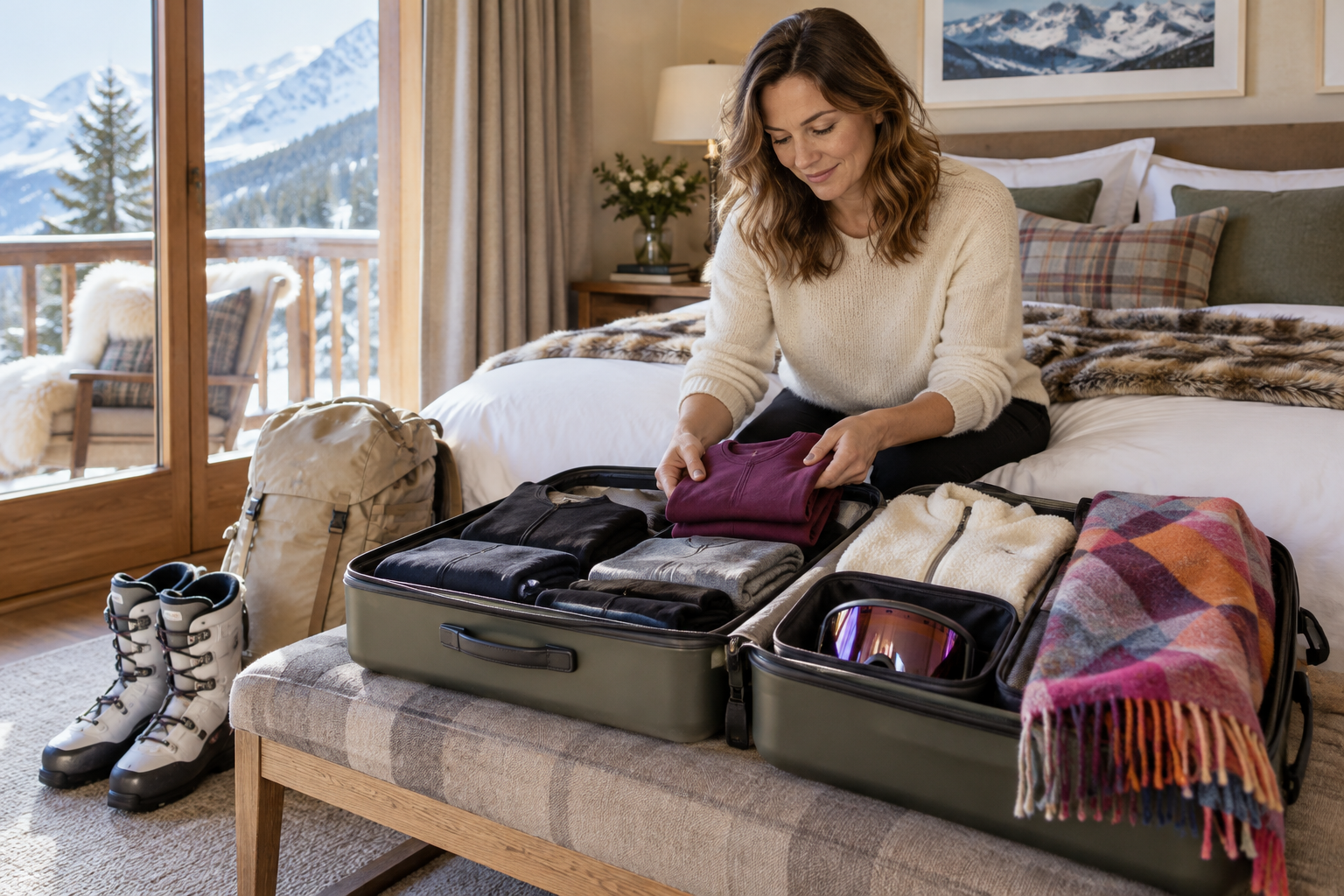
Use packing cubes for base layers and underwear, tuck small accessories into gaps, and protect goggles in their case. Don’t compress delicate lenses beneath heavy kit. Pack a separate bag for laundry and damp items, but dry everything properly before storing it at home.
Finally, check your coat pockets, charging cables and travel documents. The aim isn’t the smallest suitcase imaginable. It’s having the right kit for the mountain, something lovely and comfortable for dinner, and no unnecessary wardrobe decisions once you arrive.
Rachel Branson
Designer and founder of Art Katsura. I travel often, review hotels and retreats, and design colourful reversible pieces made for a life well travelled.